
Treating Sciatica with Osteopathy: Shahram Ghasemi's Approach in Côte Saint-Luc
Pain shooting down the leg, tingling, trouble sitting? Discover how osteopath Shahram Ghasemi approaches sciatica at Réhabital in Côte Saint-Luc — assessment, manual techniques and a realistic recovery plan.

1. Sciatica is a symptom, not a diagnosis
Every week at Réhabital in Côte Saint-Luc, patients walk into my treatment room and tell me the same story: “I have sciatica.” They describe a burning line of pain that starts in the lower back or deep in the buttock, travels down the back of the thigh, past the knee, and sometimes reaches the calf, ankle or even the outer edge of the foot. Sitting is unbearable. Driving is worse. Sleeping is a nightly negotiation with pillows.
Here is the first thing I explain: “sciatica” is not a diagnosis — it is a description of what a compressed or irritated sciatic nerve feels like. Two patients with identical leg pain can have completely different underlying causes. One may have a lumbar disc pressing on a nerve root. Another may have a spasmed piriformis muscle squeezing the nerve in the buttock. A third may have a chronically stuck sacroiliac joint pulling the whole lumbar chain out of balance. If we do not identify which mechanism is driving your sciatica, no treatment will work reliably. That is where a proper osteopathic assessment changes everything.
My name is Shahram Ghasemi. I am the founder of Réhabital, trained as a medical doctor in Iran (MD) and later as a manual osteopath (DOMP) in Canada. That double background is what shapes how I approach sciatica: I think like a physician about red flags and pathology, and I treat like an osteopath — with my hands, listening to what the tissues are actually doing. This article walks you through exactly how I evaluate and treat sciatica at the clinic, what results to realistically expect, and how to prevent it from coming back.
2. The anatomy every sciatica patient should understand
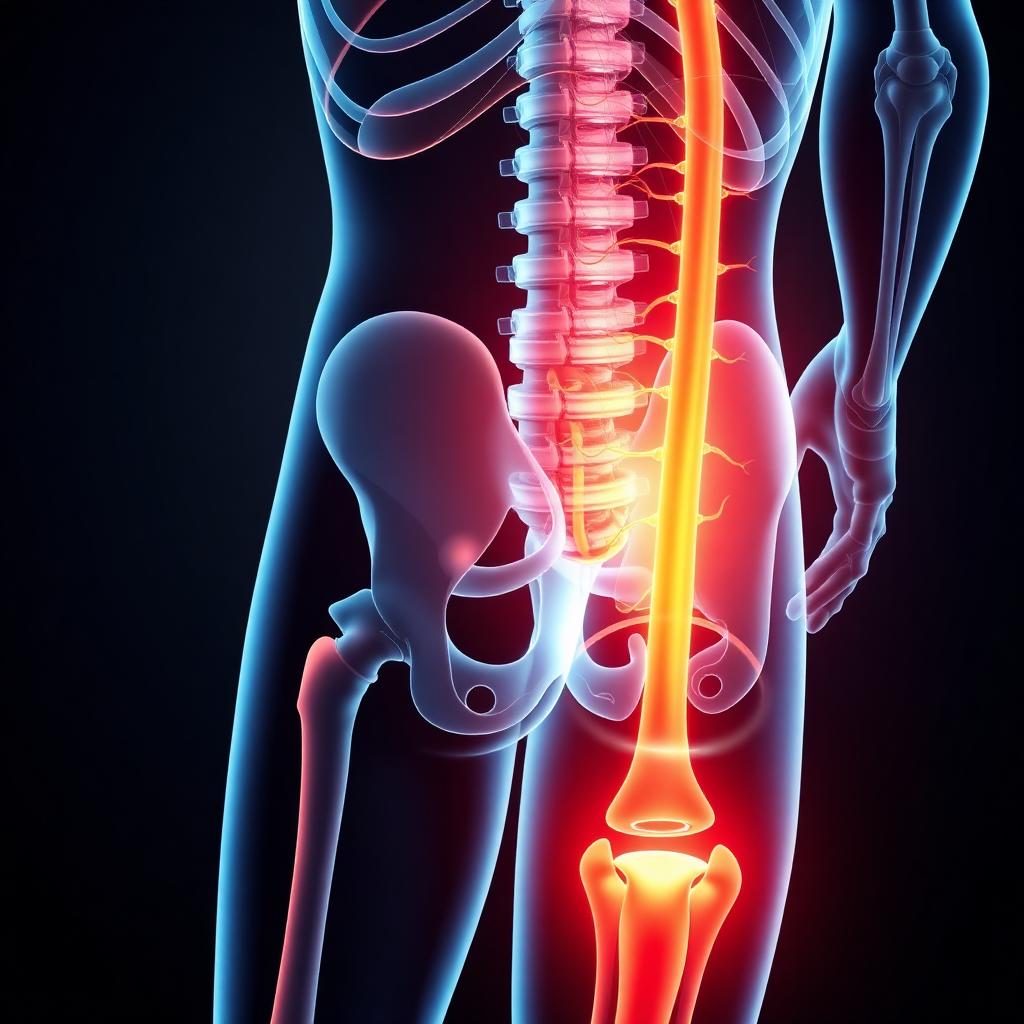
The sciatic nerve is the longest nerve in the human body. It is formed from nerve roots L4, L5, S1, S2 and S3, which emerge from the lumbar spine and sacrum, converge inside the pelvis, pass under (or through) the piriformis muscle, and then descend down the back of the thigh, splitting behind the knee into the tibial and common peroneal nerves.
That anatomical trajectory tells us exactly where things can go wrong:
- Nerve root level (spine) — a lumbar disc herniation or a narrowed foramen at L4-L5 or L5-S1 pinches a root before the sciatic nerve even forms.
- Pelvic level — a dysfunctional sacroiliac joint or an inflamed piriformis compresses the nerve as it exits the pelvis.
- Hip and buttock level — deep external rotators (gemelli, obturators, quadratus femoris) can trap the nerve; hip osteoarthritis changes the mechanics upstream.
- Along the thigh — chronic hamstring shortening or fascial tethering can maintain nerve tension long after the original irritation is gone.
Good osteopathic treatment addresses the whole chain, not just the loudest spot. That is why an isolated massage of the low back rarely fixes true sciatica.
3. What causes sciatica — the four patterns I see most often
Lumbar disc herniation or protrusion (about 40% of cases). Usually L4-L5 or L5-S1. Pain worsens with sitting, coughing, sneezing, or forward bending. There may be tingling or numbness in a specific band of the leg or foot.
Piriformis syndrome (about 25%). Pain is deep in the buttock, worse after prolonged sitting (drivers, office workers, cyclists). The straight leg raise is often less positive than in disc cases, but direct pressure on the piriformis reproduces the pain exactly.
Sacroiliac joint dysfunction (about 20%). Common after pregnancy, a fall onto the buttocks, or years of asymmetric loading. The pain sits over the SI joint and refers into the buttock and back of the thigh, usually stopping above the knee.
Facet joint irritation, spinal stenosis and mixed causes (about 15%). Older patients, degenerative changes, pain that increases with standing and walking, relieved by sitting or forward bending — a very different pattern.
4. Red flags — when osteopathy is not enough
Before any hands-on treatment, I screen for red flags that require medical, not manual, care:
- Loss of bladder or bowel control
- Saddle-area numbness (perineum, inner thighs)
- Progressive weakness in the leg or foot
- Unexplained weight loss, night sweats, fever
- History of cancer with new severe back pain
These are rare, but they matter. My medical training means I recognize them immediately and refer you where you need to go. Every other case — the vast majority — responds beautifully to structured manual care.
5. The first session at Réhabital — what actually happens
Your first visit lasts 60 minutes. About 25 minutes of that is assessment, not treatment. I want to understand your pain before I touch it.
History. When did it start? What triggered it? What makes it better or worse? Any prior back injuries, sports, surgeries, pregnancies? Your work posture, sleep position, medications, imaging you already have.
Neurological exam. Straight leg raise, slump test, reflexes at the knee and ankle, dermatomal sensation, myotomal strength. This tells me which nerve root, if any, is involved.
Biomechanical exam. Lumbar mobility in every direction, pelvic alignment, sacroiliac tests, hip range of motion, piriformis and deep rotator palpation, gait analysis, and — critically — how you sit, stand and bend.
Explanation. Before I treat, I show you on an anatomy model what I think is happening in your body, and what my treatment plan is going to do about it. Informed patients heal faster.
6. The osteopathic techniques I use for sciatica
Osteopathy is not one technique — it is a way of thinking, applied through many tools. For sciatica, my typical toolkit at Réhabital includes:
- Soft-tissue release of the paraspinals, quadratus lumborum, gluteals and hamstrings — to unload the muscular grip on the nerve.
- Myofascial release of the piriformis and deep hip rotators — often the single most relieving technique for buttock-dominant sciatica.
- Articular mobilization of the lumbar spine — gentle rhythmic techniques (never high-velocity thrusts on an acute nerve) to restore segmental motion at L4-L5 and L5-S1.
- Sacroiliac joint balancing — muscle energy techniques and gentle mobilizations to restore symmetry.
- Hip capsule work — because a stiff hip forces the low back to compensate on every step.
- Neural mobilization (nerve glides) — specific gentle movements that slide the sciatic nerve through its tunnel and reduce mechanical sensitivity.
- Diaphragm and visceral work when the abdominal pressure system is contributing to lumbar loading.
Everything is calibrated to your tolerance. On an acutely inflamed nerve, less is more.
7. Your home program — the other half of recovery
What you do between sessions matters as much as what happens on the table. Every sciatica patient at Réhabital leaves the first visit with a short, realistic home plan:
- Walk daily — 15 to 30 minutes, flat ground, comfortable pace. Movement is medicine for a compressed nerve.
- Nerve glides — 2 sets of 10, twice a day, taught in session. These are not stretches; they are gentle mobilizations of the nerve inside its sheath.
- Break up sitting — every 30 to 45 minutes, stand up and move for 2 minutes. Sitting is the single biggest aggravator of sciatica.
- Sleep position — on the side with a pillow between the knees, or on the back with a pillow under the knees. Avoid sleeping on the stomach until the acute phase resolves.
- Ice or heat — ice for the first 48 to 72 hours if the pain is sharp and inflammatory; heat afterwards for muscular tension.
- What to avoid — heavy lifting, deep forward bends, long car trips, running on hard surfaces, and any exercise that reproduces the leg pain.
8. Realistic timelines — what recovery looks like
Every case is different, but here is what I typically see:
Acute sciatica (less than 6 weeks of symptoms): 3 to 5 sessions over 4 to 6 weeks. Most patients report 50 to 70% relief after the first two visits.
Subacute sciatica (6 to 12 weeks): 5 to 8 sessions over 8 to 10 weeks, with home program compliance being the main determinant of success.
Chronic or recurrent sciatica (over 3 months, or multiple episodes): 8 to 12 sessions, then maintenance every 6 to 8 weeks. We are undoing years of adaptation, so patience matters.
Post-surgical sciatica or confirmed severe disc herniation: Longer, more careful, always in coordination with your physician or surgeon.
9. When we combine osteopathy with other services
Réhabital is a multidisciplinary clinic on purpose. For sciatica, the most effective combinations we build are:
- Osteopathy + deep tissue or sports massage — I clear the joint and neural components; a certified massage therapist works the muscular chains between visits.
- Osteopathy + physiotherapy — once the acute pain is under control, physiotherapy rebuilds core strength, glute activation and load tolerance.
- Osteopathy + naturopathy — for patients whose systemic inflammation, sleep or stress is slowing recovery.
We coordinate care internally so you are never repeating your story.
10. Preventing sciatica from coming back
Once your pain is gone, the goal shifts from treatment to protection. My three-pillar prevention plan for every sciatica patient:
1. Daily mobility (10 minutes). Hip openers, cat-cow, hamstring floss, glute stretches. Consistency beats intensity.
2. Strength 2 to 3 times per week. Bridges, dead bugs, bird dogs, side planks, hip hinges. A strong core and strong glutes are the best insurance against a second episode.
3. Manage sitting. A supportive chair, a stand-desk option if possible, and — non-negotiable — micro-breaks every 45 minutes. Long uninterrupted sitting is the single most reliable way to reload a healing disc.
Add maintenance osteopathy every 6 to 8 weeks and most of my long-term patients stay episode-free for years.
11. A note on imaging
Many patients arrive with an MRI showing a disc bulge and assume that image is the reason for their pain. It might be — but the correlation between imaging and symptoms is famously weak. Studies consistently show that a large percentage of pain-free adults over 40 have disc bulges on MRI. What matters clinically is how the tissue behaves under load, and how the nervous system responds to that load. Osteopathic assessment answers that question far better than a static image.
If you already have imaging, bring it — it helps me build the full picture. If you do not have any, I will tell you honestly whether we need it before proceeding.
12. Booking sciatica treatment with Shahram Ghasemi in Côte Saint-Luc
Réhabital is located at Cavendish Mall, D4-5800 boulevard Cavendish, Côte Saint-Luc, with free indoor parking, a bilingual team, and evening and weekend availability. We welcome patients from Côte Saint-Luc, Hampstead, NDG, Snowdon, Montréal-Ouest, Westmount, Saint-Laurent and the whole West Island.
If sciatica is stopping you from sleeping, sitting through a meeting or picking up your kids, do not wait for it to “sort itself out.” Book an assessment. I will tell you within one visit whether osteopathy is the right tool for your case — and if it is not, I will tell you what is.
Reserve online 24/7 through Jane App, call 438-842-3550, or read more on our osteopathy service page and the dedicated sciatica treatment page.
Frequently asked questions
Go deeper with our dedicated osteopathy pages
Osteopathy pages with Shahram Ghasemi, MD (Iran), DOMP in Côte Saint-Luc:
Related articles
Osteopathy and sciatica: how to durably relieve sciatic nerve pain
How osteopathy identifies the mechanical cause of sciatica — disc, sacroiliac or piriformis — and relieves pain in a few sessions at Réhabital in Côte Saint-Luc.
Sciatica Pain Explained: Causes, Symptoms and How Osteopathy Brings Lasting Relief
Sharp, burning pain shooting from your lower back down the leg? Discover the most common causes of sciatica and how our osteopaths in Côte Saint-Luc relieve it without medication or surgery.
Herniated Disc, Sciatica or Piriformis Syndrome: How to Tell Them Apart
Pain shooting down your leg? It is not always “sciatica.” Learn how to tell a herniated disc, a true radicular sciatica and a piriformis syndrome apart — and how osteopathy and physiotherapy at Réhabital in Côte Saint-Luc treat each one differently.

Sciatica at Night: Why Pain Worsens After Dark and How Osteopathy Helps You Sleep Again
Tossing, turning, woken up by a burning leg at 3 a.m.? Discover why sciatica intensifies at night and how our osteopaths in Côte Saint-Luc help patients sleep deeply again.
Sciatica, Desk Posture and Bad Sleeping Positions: How Osteopathy Breaks the Cycle
Eight hours seated, then eight hours in a bad sleeping position: that is where most sciatica begins. Learn the exact mechanisms, the positions to correct, and how osteopathy in Côte Saint-Luc delivers lasting relief.
Is Osteopathy Good for Back Pain? A Complete Guide
Discover how osteopathy treats lower back, upper back and neck pain. Scientific studies, techniques used and expected results in Côte Saint-Luc.