
Hamstrings and Osteopathy: Strain, Proximal Tendinopathy and a Complete Rehabilitation Guide
Strain, proximal tendinopathy or referred pain? Our osteopath Shahram Ghasemi explains how to tell the four hamstring problems apart and the full rehabilitation progression we use in Côte Saint-Luc.
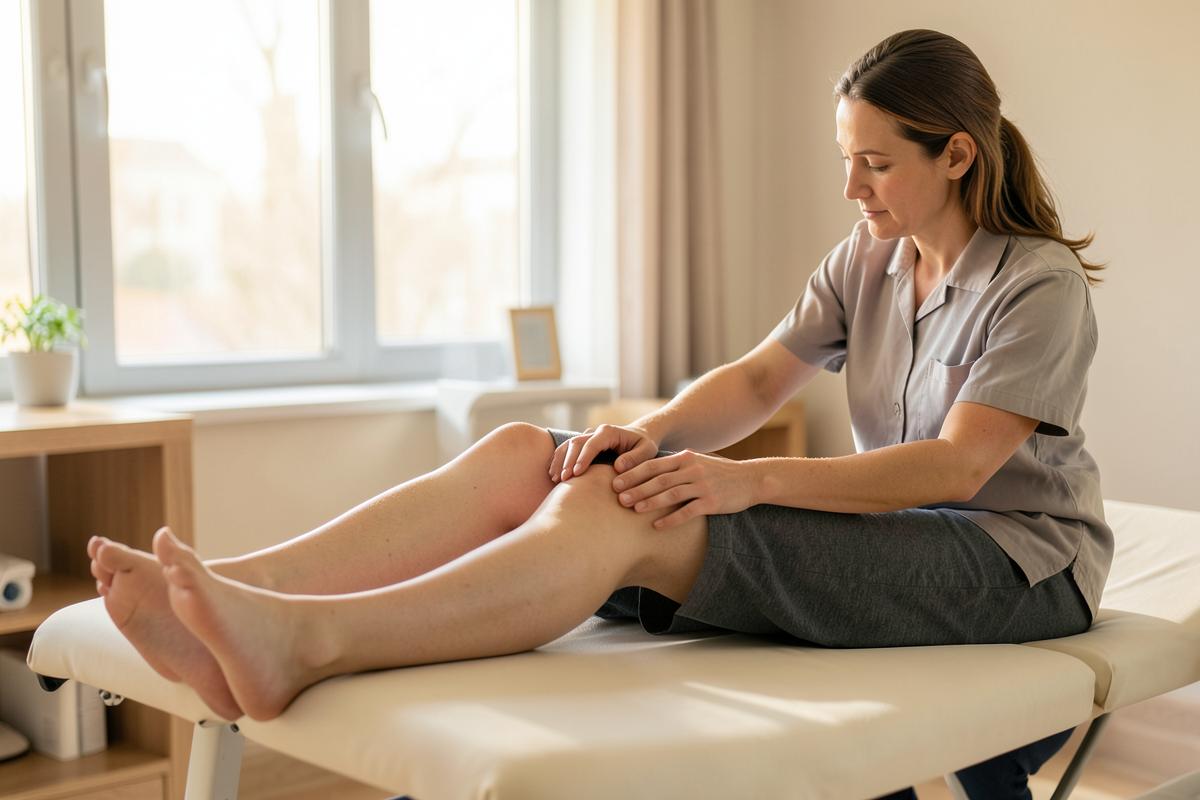
Hamstring problems are among the most stubborn complaints we see in our osteopathy room at Réhabital in Côte Saint-Luc. A sprinter feels a sudden grab at the back of the thigh. A runner develops a deep ache right under the sitting bone that only appears after twenty minutes. An office worker feels the back of the thigh pull every single morning. Three completely different problems, three completely different treatment plans — and one muscle group that gets blamed for all of them.
This guide covers hamstring injury and dysfunction in depth: the anatomy that matters clinically, how to tell a strain from a tendinopathy from referred nerve pain, what osteopathic treatment actually does, and the full rehabilitation progression we use week by week. If your main complaint is stiffness rather than pain, our companion article on tight hamstrings and why stretching alone fails is the better starting point.
The anatomy that changes your treatment
The hamstring group is three muscles: biceps femoris (long and short heads) on the outside, semitendinosus and semimembranosus on the inside. Except for the short head of biceps femoris, all of them cross two joints — the hip and the knee. That single fact explains most hamstring injuries: a two-joint muscle can be lengthened at both ends simultaneously, and that is exactly what happens during the late swing phase of sprinting, when the hip is flexing while the knee is extending.
The proximal tendon anchors on the ischial tuberosity — your sitting bone — millimetres from the sciatic nerve and beneath the sacrotuberous ligament, which continues upward into the sacrum and the thoracolumbar fascia. This is why hamstring problems are almost never local. A restricted sacroiliac joint, a rotated pelvis or a stiff lumbar spine changes the resting tension of that tendon before you take a single step.
Four distinct problems, often confused
1. Acute hamstring strain
A sudden, identifiable moment: sprinting, a stretch beyond control, a slip. Pain is sharp, often with a visible bruise appearing over 24 to 72 hours. Most strains occur at the musculotendinous junction of biceps femoris. Grade I means a few fibres and near-normal strength; grade II means clear strength loss and a limp; grade III is a full rupture, which needs imaging and possibly surgical referral.
2. Proximal hamstring tendinopathy
No dramatic moment. A deep, localized ache at the sitting bone that worsens with sitting on hard surfaces, driving, uphill running and deep hip flexion. This is a load-tolerance problem in the tendon, not a tear, and it responds to progressive loading — never to rest alone or to aggressive stretching, which compresses the tendon against the bone and makes it worse.
3. Referred pain from the lumbar spine or sciatic nerve
Pain in the back of the thigh with no tenderness on palpation, no clear injury and no strength loss is often neural or referred. The slump test reproduces it, neck flexion changes it, and the symptoms move around. Treating this as a muscle injury wastes months. Our articles on osteopathy and sciatica and sciatica, sitting and sleep posture cover this pattern.
4. Chronic protective tone with no injury at all
Weak glutes, a poorly controlled pelvis and eight hours of sitting keep the hamstrings permanently on duty. They feel short and sore but test strong and are never truly injured. This is the most common presentation in a clinic like ours.
How we assess a hamstring at Réhabital
Shahram Ghasemi, MD (Iran), DOMP, is the osteopath who conducts these assessments in Côte Saint-Luc. The examination is deliberately broader than the thigh:
- Palpation mapping. Point tenderness exactly on the ischial tuberosity points to proximal tendinopathy. Tenderness in the mid-belly points to a strain. No tenderness at all points away from both.
- Resisted testing at several knee angles. Pain and weakness at 15 degrees of knee flexion behaves differently from pain at 90 degrees, and this distinguishes tendon from muscle belly.
- Active knee extension and straight-leg raise. Range compared side to side, then repeated with the neck flexed to detect neural involvement.
- Pelvic and lumbar screening. Sacroiliac mobility, innominate rotation, lumbar segmental play. A pelvis fixed in anterior tilt keeps the proximal tendon under permanent pre-load.
- Hip and glute function. Single-leg bridge, prone hip extension timing, hip internal rotation range. Restricted hip extension forces the hamstring to work at a mechanical disadvantage.
- Load and history review. Sudden training spikes, new hill running, a change of shoes, a long drive, a new desk setup.
What osteopathic treatment actually does
Manual treatment does not repair torn fibres — nothing does that except time and appropriate load. What it does is remove the mechanical reasons the tissue is overloaded and reduce the protective response that limits your rehabilitation:
- Pelvic and sacroiliac normalization, so the ischial tuberosity is not held in a lengthened, pre-tensioned position all day.
- Lumbar segmental mobilization, reducing the referred and neural component of posterior thigh pain.
- Myofascial work along the posterior chain — sacrotuberous ligament, thoracolumbar fascia, calf and plantar fascia — because the hamstring is one link in a continuous chain.
- Neural mobilization when the slump test is positive, restoring sciatic glide rather than stretching a sensitized nerve.
- Hip capsule and glute work, restoring extension and rotation range so the hamstring stops compensating.
- Graded exercise prescription, reviewed and progressed at every visit.
For a first visit, our guide to what to expect at your first osteopathy consultation explains the format, and how many sessions you need sets realistic expectations.
Working alongside physiotherapy and massage therapy
Hamstring rehabilitation is one of the clearest cases for combining disciplines. Our physiotherapist Colin Teghen Tamuton handles the strength and return-to-sport phases in physiotherapy — progressive loading, sprint mechanics, criteria-based return to running. On the soft-tissue side, Cedik Elaiba (deep tissue and Swedish), Irina Kushnir (therapeutic, deep tissue, Swedish) and Jeanne Andrea Rahantamalala (therapeutic, deep tissue, Swedish, hot stone, lymphatic) provide massage therapy that improves circulation and reduces the compensatory tension in calves, glutes and lumbar muscles. Our comparison of osteopathy and physiotherapy explains how the roles differ.
The rehabilitation progression we prescribe
Phase 1 — protect and activate (days 0 to 7 for a strain)
- Relative rest: keep walking, avoid sprinting, deep lunging and aggressive stretching.
- Isometric hamstring holds at short range: 5 × 20 seconds, pain under 3/10.
- Glute bridges, feet close to the buttocks: 3 × 12.
- Gentle nerve glides if the slump test is positive.
Phase 2 — restore range under load (weeks 1 to 3)
- Single-leg glute bridge: 3 × 10 per side.
- Prone hamstring curl with band: 3 × 12, controlled tempo.
- Hip hinge with dowel: 3 × 10, teaching the pelvis to rotate instead of the lumbar spine.
- Short-lever eccentrics such as the sliding leg curl: 3 × 6.
Phase 3 — build strength through range (weeks 3 to 8)
- Romanian deadlift, light then progressive: 3 × 8.
- Single-leg Romanian deadlift: 3 × 8 per side.
- Nordic hamstring curl, eccentric only: 3 × 5, added slowly — this is the single most evidence-supported exercise for reducing hamstring reinjury.
- Long-lever bridge with heels on a bench: 3 × 10.
Phase 4 — return to speed (weeks 8 and beyond)
- Progressive running: strides at 60%, then 75%, then 90% over two to three weeks.
- A-skips, high-knee drills and acceleration work before any maximal sprinting.
- Return criteria: full pain-free range, strength within 10% of the other side, and two weeks of symptom-free running.
For proximal tendinopathy the progression is similar but slower, and hip-flexion compression is limited early: no deep stretching, no sitting on hard edges, no uphill running until the tendon tolerates isometrics comfortably.
The mistakes that keep hamstrings injured
- Stretching a healing or compressed tendon. The most common self-inflicted setback we see.
- Returning to sprinting because pain has gone. Pain disappears long before strength returns; reinjury rates within two months are high for exactly this reason.
- Treating only the thigh. A hamstring that keeps failing usually has a pelvic, lumbar, hip or calf driver behind it.
- Complete rest. Unloaded tendons lose capacity quickly. Movement within tolerance is the treatment.
- Ignoring sleep and workload. Poor sleep and sudden training spikes are two of the strongest predictors of soft-tissue injury.
How long recovery takes
A grade I strain typically resolves in two to four weeks, a grade II in six to twelve, and proximal hamstring tendinopathy commonly needs three to six months of progressive loading. Chronic protective tone with no injury usually improves within three to five osteopathy sessions combined with a home program. Timelines depend far more on load management than on treatment frequency.
Booking in Côte Saint-Luc
Réhabital is located at Cavendish Mall in Côte Saint-Luc with free parking, evening availability six days a week and receipts for private insurance. Note that we do not accept CNESST or SAAQ claims. Explore our osteopathy service, review our published rates, or book directly online with Shahram Ghasemi.
Frequently asked questions
Go deeper with our dedicated osteopathy pages
Osteopathy pages with Shahram Ghasemi, MD (Iran), DOMP in Côte Saint-Luc:
Related articles
Tight Hamstrings: Why Stretching Alone Fails and Which Exercises We Prescribe in Osteopathy
Tight hamstrings are rarely fixed by stretching alone. Here are the real causes, the tests we run in clinic, and the exercise program our osteopaths prescribe in Côte Saint-Luc.
Treating Sciatica with Osteopathy: Shahram Ghasemi's Approach in Côte Saint-Luc
Pain shooting down the leg, tingling, trouble sitting? Discover how osteopath Shahram Ghasemi approaches sciatica at Réhabital in Côte Saint-Luc — assessment, manual techniques and a realistic recovery plan.
Osteopathy vs Physiotherapy: Which Approach Should You Choose in Côte Saint-Luc?
Complete comparison between osteopathy and physiotherapy: differences, indications, training, insurance reimbursement and how to choose based on your condition in Côte Saint-Luc, Hampstead, NDG and across Montreal.
Best Treatment for Back Pain: How Osteopathy Provides Lasting Relief
Discover why osteopathy is considered one of the best treatments for back pain. Evidence-based manual therapy for chronic and acute back pain in Montreal.
Low Back Pain and Osteopathy: The Complete Guide to Understanding, Relieving and Preventing It
Why your back pain keeps coming back, what osteopathy really does for lumbar pain, and the full treatment plan our osteopaths use in Côte Saint-Luc.
Is Osteopathy Good for Back Pain? A Complete Guide
Discover how osteopathy treats lower back, upper back and neck pain. Scientific studies, techniques used and expected results in Côte Saint-Luc.