
Stiff Neck and Torticollis: What to Do and Where Osteopathy Fits
Woke up with a stiff neck? Safe first steps, warning signs and realistic expectations for osteopathy in Côte Saint-Luc, Montréal.
Can osteopathy help a suddenly stiff neck?
Waking with a stiff neck can make ordinary tasks surprisingly difficult. Looking behind you, getting dressed or settling into bed may become uncomfortable. An osteopathy assessment can help explore painful movement and whether an individualized manual approach is appropriate, provided your symptoms do not first require medical attention. It cannot guarantee an instant release or identify every possible cause on its own. Gentle movement, manageable activity and attention to changes in symptoms are useful starting points for many uncomplicated episodes.
At Réhabital in Côte Saint-Luc, on the Island of Montréal, our osteopathy service page explains the service and booking options. This article focuses on sudden adult neck stiffness: what to do initially, what not to force and when to seek an assessment. It complements our broader guide to osteopathy and neck pain rather than treating every neck problem as the same condition. General information can support a decision, but it does not replace a diagnosis or advice tailored to your medical history.
Muscle spasm, stiffness and torticollis are not identical
People often use “muscle spasm” or “knot” to describe a tight, painful area. That feeling does not establish that one muscle explains the entire problem. Several tissues and pain mechanisms may contribute to restricted neck movement. Torticollis generally describes a tilted or rotated head position with limited, sometimes painful movement. It describes a presentation rather than a single proven cause. You can also experience neck stiffness without your head remaining tilted, and similar symptoms may arise in different circumstances.
Infant torticollis is a separate situation; this adult guide is not a treatment plan for babies. For adults, assessment helps distinguish relatively straightforward local discomfort from symptoms that warrant medical investigation. A blocked feeling does not mean a vertebra has slipped out of place or needs to be cracked back in. Strong pain can be temporary, but intensity alone cannot tell you whether a problem is harmless. The onset, associated symptoms and your health history all matter when deciding what to do next.
Why might your neck feel stuck after sleep?
An unfamiliar sleeping position, a different pillow or a long period without changing position can precede stiffness. None of these proves that your bedding caused it. Your neck may already have been sensitive after a demanding activity, unusual exercise or several busy days. Notice what changed rather than assuming one object is responsible. Repeated morning symptoms deserve a broader discussion about daily activities, recovery and sleep, especially if the pattern persists despite reasonable changes or starts affecting what you can do.
A new pillow is not a universal solution. Height and comfort are more relevant than a brand or a therapeutic promise. Look for support that does not strongly push your head upward or let it drop. If sleeping on your stomach keeps your neck turned and increases discomfort, try another position. There is no perfect alignment everyone must maintain throughout the night. A tolerable position, adequate support and the ability to change position are more useful starting points than trying to rigidly control every movement.
Screens, stress and repetitive tasks: look beyond posture
Long stretches at a computer or looking down at a phone may coincide with neck tension. This is not necessarily evidence of a permanently bad posture. Sustained positions, repetitive tasks or unfamiliar loads can become difficult to tolerate, particularly when sleep has been disrupted. Switching tasks and positions is often more practical than holding one supposedly ideal position all day. Adjustments should be guided by comfort and function rather than by how straight you look in a photograph of your workstation.
Stress can accompany muscle tension and influence how pain is experienced without making the pain imaginary. During an assessment, information about work demands, breaks, training and everyday responsibilities helps make advice realistic. Someone carrying a child or working in a kitchen faces different demands from someone using several screens. The aim is to identify a few workable changes, not to label ordinary movements as dangerous. You should leave with an understandable plan rather than a list of activities you are afraid to attempt.
Red flags: when not to wait for an osteopathy appointment
A stiff neck with fever, a severe headache, confusion, unusual sleepiness or marked sensitivity to light can indicate a serious problem. A rash that does not fade under pressure is another warning sign, but the absence of a rash does not rule out an emergency. Do not wait for every symptom to appear. If meningitis is suspected or the person seems seriously unwell, call 911. Hands-on care is not an appropriate first response to this situation and must not delay urgent medical assessment.
Significant recent trauma, new or worsening weakness, difficulty walking or unusual hand clumsiness also require prompt medical evaluation. Sudden trouble speaking, facial asymmetry or weakness on one side of the body warrants calling 911. Our guide to when to see a doctor outlines other concerning situations. In Québec, Info-Santé 811 can help direct non-emergency questions. It is not a substitute for emergency services, and a routine clinic booking should never become a reason to postpone urgent care.
Pain going down an arm needs a different discussion
Pain traveling from the neck into an arm, tingling, numbness or weakness may suggest nerve involvement rather than an isolated stiff muscle. Assessment is needed to understand the pattern and decide what follow-up is appropriate. Increasing loss of strength should not simply be attributed to tension. Mention an unusually cold arm or an unexpected change in sensation as well. The fact that symptoms start around the neck does not make all arm symptoms a straightforward problem for manual treatment to resolve.
Our article on cervical radiculopathy and a pinched nerve explains these differences. Tingling has several possible causes, and an online article cannot distinguish them for you. Medical evaluation becomes especially important when weakness or sensory loss progresses. Before deciding between hands-on care and an exercise programme, the priority is to establish whether investigation or a different type of care is needed. Do not force neck stretches in an attempt to chase arm symptoms away.
The first hours: gentle movement instead of force
Without warning signs, try to continue light activities and use small movements within a comfortable range. Slowly turning your head or changing position may be preferable to keeping the neck completely still all day. Do not push sharply through resistance or copy a “release your neck in ten seconds” video. Sharp pain, dizziness or symptoms spreading into the arm are reasons to stop and seek advice rather than repeat the movement more aggressively. The goal is tolerable movement, not proving how far your neck can turn.
Heat or cold may provide temporary comfort. Protect your skin with a cloth, avoid extreme temperatures and do not fall asleep on a heat source. Be particularly careful if skin sensation is reduced. These measures do not address every cause and should not delay needed assessment. Ask a pharmacist about pain medication that fits your health, current medicines and contraindications. This guide does not recommend a particular drug or dose, and medication should not be used to conceal concerning symptoms so you can continue a risky activity.
Driving, working and exercising with a stiff neck
Avoid driving or cycling if you cannot turn your head sufficiently to monitor traffic or check blind spots. Being able to carry out a safety manoeuvre matters more than simply being able to tolerate pain. At work, temporary changes might include keeping useful items closer, reducing tasks that clearly aggravate symptoms and varying positions. Short, regular breaks can be more practical than an elaborate exercise routine that does not fit your day. Discuss significant work limitations rather than forcing your way through them indefinitely.
Training may need temporary changes as well. Reduce loads or movements that provoke substantial pain instead of testing the neck with maximal effort. Walking and easy activities may remain possible depending on symptoms. After a fall, sports impact or unusual pain, do not resume simply because massage feels soothing. Seek an assessment appropriate to the event. Return to activity is better built gradually around what you can manage without concerning deterioration, rather than around a fixed deadline or the expectation of an instant correction.
What happens during an osteopathy assessment?
The conversation starts with when symptoms began, how they have changed and which activities are affected. Mention recent accidents, illness, medication and neurological symptoms even if they seem unrelated. Depending on your situation and consent, the practitioner may examine neck movement and nearby areas. The assessment should help identify functional difficulties and whether medical referral is preferable. Feeling a tight area with the hands is not enough to exclude every serious cause, and no single movement test answers every question about neck pain.
If manual care appears appropriate, the options and limitations should be discussed before treatment. You can decline a technique, request a gentler approach or stop a session. A rapid neck manipulation is not a requirement for receiving care. To learn about the founder’s background, visit Shahram Ghasemi, MD (Iran), DOMP. A professional biography does not replace an individual conversation about possible benefits, risks and alternatives. Your preferences and the findings of your assessment should shape the approach, not a predetermined technique applied to everyone.
Manual therapy: realistic expectations and limited evidence
Gentle mobilization or soft-tissue work may be considered after assessment. Some people experience less pain or easier movement following manual care, but responses vary. Research on manual therapy does not show that every osteopathic technique corrects torticollis or that one appointment is enough. A 2024 systematic review reported possible benefits for neck pain while rating the evidence as limited in certainty. Its results do not establish a guaranteed outcome for your situation or justify describing treatment as a cure.
Progress should also be measured through function: looking sideways more comfortably, sleeping better or returning to an activity. Temporary relief is not proof that a structure was put back into place. If symptoms stay unchanged, worsen or develop a different pattern, the plan needs reassessment. Individualized advice and suitable exercises can accompany hands-on care. No approach should require ignoring warning signs or repeating appointments without clear, shared goals. An honest plan includes what to do if improvement does not occur, not only what might help.
Osteopathy, physiotherapy or massage therapy?
The choice depends on the presentation, your goals and the assessment, not only the label you give the pain. Physiotherapy can help assess function and develop a progressive movement or strengthening programme. Massage therapy may offer muscular comfort, but it does not replace investigation when neurological symptoms are present. Osteopathy is another possible manual-care option. You do not necessarily need all three approaches at once; a coherent plan and appropriate referral are more valuable than automatically adding more treatments to an uncertain problem.
Read our osteopathy and physiotherapy comparison and our physiotherapy guide for neck pain for further context. Useful follow-up should specify what you want to regain and when results will be reviewed. There is no universal session count for a stiff neck. Improvement may allow appointments to be spaced out, while deterioration may require another assessment instead of repeating the same care. The appropriate next step can change as new information becomes available.
When to book and what to bring to the appointment
Seek advice if pain is substantial, clearly limits everyday life, keeps returning or does not improve. You do not have to wait weeks with worrying symptoms. Note the onset, difficult positions, changes in sensation and what you have already tried. This short account is more useful than arriving with a confident self-diagnosis. Imaging is not automatic for every stiff neck; its usefulness depends on symptoms, history and medical assessment. If another clinician has provided instructions or relevant reports, bring them for discussion.
Our neck pain information page gathers related clinic information. Standard fees are available in the shared fees catalogue rather than copied into this article. Réhabital offers a 10% discount at the first clinic visit, excluding physiotherapy. It applies to the first visit to the clinic, not a separate first visit in each specialty. For a non-urgent situation, you can book through Jane App. When warning signs are present, choose the appropriate medical assessment instead.
Sources and limitations
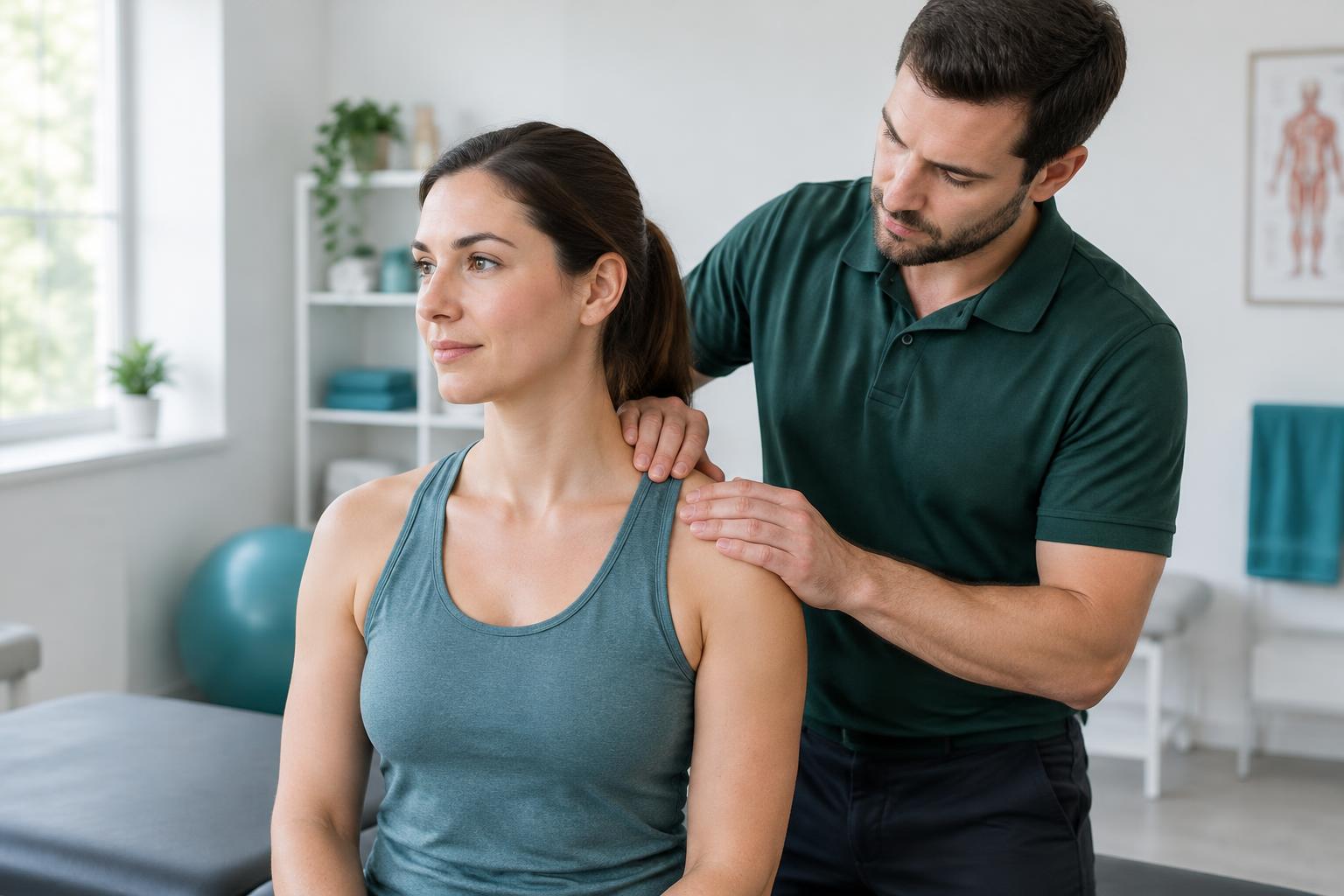
These sources support general guidance and the limitations of manual care. They do not validate clinic-specific outcomes. The illustration is generated and does not depict an actual appointment or a member of our team.
Frequently asked questions
Go deeper with our dedicated osteopathy pages
Osteopathy pages with Shahram Ghasemi, MD (Iran), DOMP in Côte Saint-Luc:
Related articles

Neck Pain: How Osteopathy Treats Chronic Cervical Pain
Neck pain, stiff neck, trapezius tension and tension headaches: why osteopathy is one of the most effective approaches in Montreal for lasting cervical pain relief.
Osteopathy and Neck Pain: How Visceral Osteopathy Treats the Neck Pain That Keeps Coming Back
Neck pain does not always come from the neck. The diaphragm, stomach, liver, pericardium and chest fascia can pull on the cervical spine through precise anatomical chains. Here is how visceral osteopathy fits into chronic neck pain care in Côte Saint-Luc.
Osteopathy: 4 Conditions Where a Whole-Body Assessment May Help
SI joint dysfunction, infant torticollis, plagiocephaly and colic: understand the careful, complementary role of osteopathy in Côte Saint-Luc.

Pain After Sitting for a Long Time: Why Does Your Back Stiffen Up?
You stand up from your desk or a long car ride and your back is stiff and sore? Discover why this happens and how osteopathy can help.

Sciatica at Night: Why Pain Worsens After Dark and How Osteopathy Helps You Sleep Again
Tossing, turning, woken up by a burning leg at 3 a.m.? Discover why sciatica intensifies at night and how our osteopaths in Côte Saint-Luc help patients sleep deeply again.
Hip Pain When Walking or Sleeping on Your Side: Possible Causes and Treatments
Pain on the side of the hip at night or while walking? Gluteal tendinopathy, bursitis, femoroacetabular impingement or osteoarthritis: here is how to tell them apart.